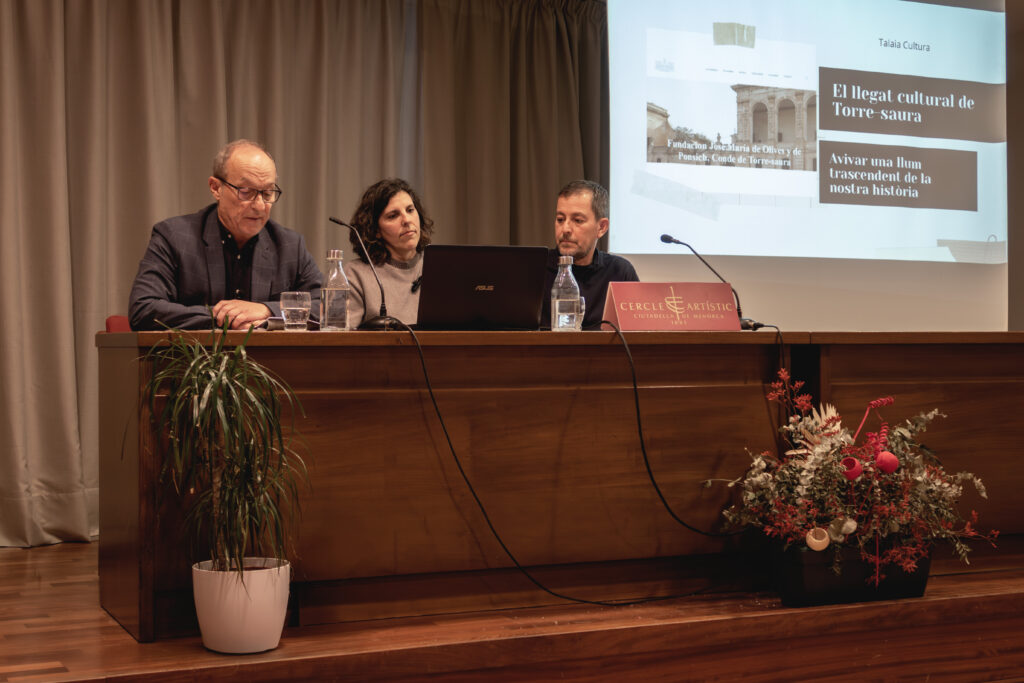
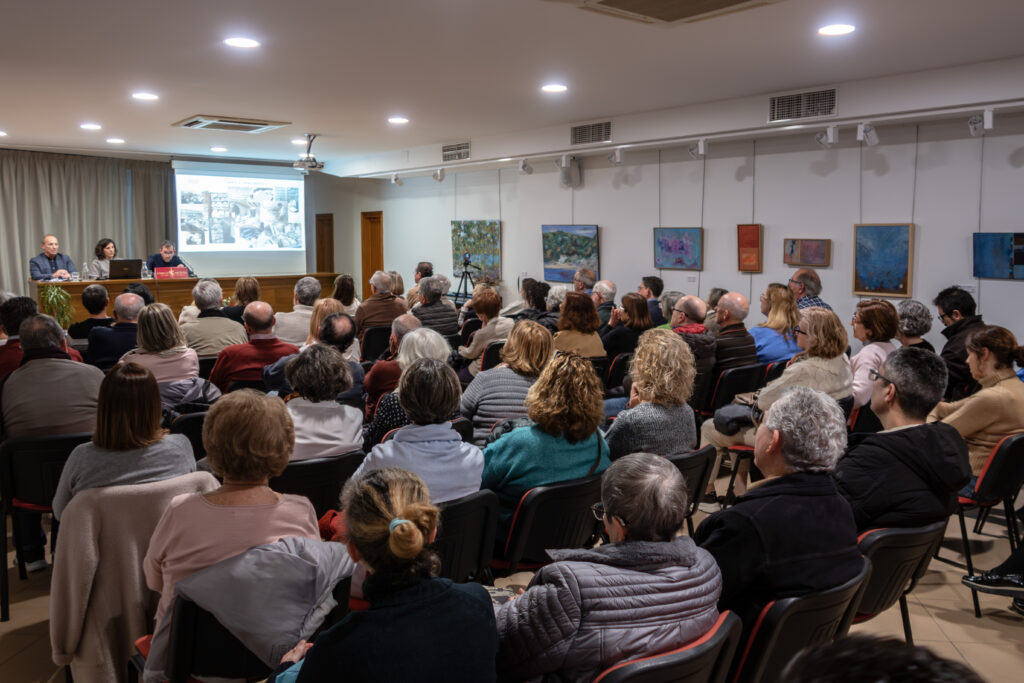
Under the title “The Cultural Legacy of Torre-saura. Igniting a Transcendent Light in Our History” the Cercle Artístic has dedicated one of its regular Friday lectures to highlighting the historical, cultural, and social value of the Torre-saura County heritage and the work the Foundation has been carrying out in this regard since 2021. The speakers were historian Antoni Camps Extremera, former president of the Cercle Artístic Alberto Coll de Arredondo, and the Cercle Artístic’s librarian, Martina Moll Llorens. Among the audience, which was quite numerous, was Guillermo de Olives Olivares, vice president Fundación José María de Olives y de Ponsich, Conde de Torre-saura.
Origin of the Foundation
The former president of the Cercle Artístic, Alberto Coll, who was in charge of conducting the event, took the floor to recall the origin and purpose of The Fundación José María de Olives y de Ponsich, Conde de Torre-saura.
“When José María de Olives y de Ponsich, sixth Count of Torre-saura, died, the entire set of material assets, including the palace, passed into the hands of his trusted man, Juan Valero Fortuny,” Coll introduced. With the aim of preserving this heritage and preventing its fragmentation, in 2012, Valero Fortuny created the Foundation, an institution that became the owner of the assets, with two very distinct focuses. On the one hand, the social focus, with various programs in collaboration with different charitable organizations. And on the other hand, the promotion and dissemination of the history of the county and of Menorca, which also involves the recovery, conservation, and dissemination of the historical, documentary, artistic, architectural, and ethnological heritage of the former county. “Which is extensive in both quantity and quality,” Coll added.
The opening of the palace to the public, the rehabilitation of its facades, the cataloging of the library, the restoration of works of art, or the recovery of important ethnological structures are some of the projects that, since 2021, have been launched in partnership with Talaia Cultura SL. “The first project, initiated by the then-manager, Josep Estruch, was the preservation of the immense documentary archive of the former county,” Coll said, before handing over to archivist Martina Moll.
The importance of documentary heritage
The current librarian of the Cercle Artístic began her remarks by reflecting on the importance of caring for documentary heritage. “It is an essential source for constructing the historical narrative,” Moll said, adding that it must be preserved out of responsibility, memory, and identity. “We also have to provide access to it and be able to pass the information on to future generations,” she added.
On this basis, Martina Moll outlined the work of cleaning, description, cataloging, and classification that has been done —and continues to be done— on the Cas Comte documentary collection. “The result is accessible through ATOM, an archival software where all the work is located and where you can search for all the described documents. You can browse through the collection,” Moll explained.
Before concluding, she referenced Google Analytics usage statistics, which show that in the last month the county archive’s website received nearly 130 visits. “A lot of work has been done, but there is still much more to be done,” Moll concluded.
The challenge of opening the palace to the public
Finally, Toni Camps, historian and head of historical heritage at Fundación José María de Olives y de Ponsich, Conde de Torre-saura, spoke, acknowledging the great challenge posed by opening the count’s house to the public. “A tremendous effort has been made to rehabilitate numerous spaces and recover a very important part of historical and artistic assets,” Camps said, outlining his remarks in four areas.
Archive and library
A historical documentary fund of a private residence like Cas Comte is of great value. It is the written accumulation of all the activities carried out by the members of the second branch of the Olives family over the centuries. It reflects the personal and public offices and positions they have held, the policies of matrimonial alliances, the administration of their properties… A historical archive is crucial for the upkeep of a household. It justified how they had received the properties, privileges, jurisdictions… This explains why there is such a voluminous and important documentary fund and everything it has represented for Ciutadella and for Menorca,” Camps recounted.
In this regard, the documents recovered have been countless. Some of them, in very poor condition, have required significant cleaning work. We have battled dirt, humidity, mold, and even mice.
Regarding the collection’s subject matter, many judicial documents and those related to the transfer of inheritances and estates have been identified. Also abundant are notarial records, those related to the personal and public occupations of the house’s members over time, records for the administration of estates and properties, accounting documentation, and strictly personal and private papers.
The value of the house’s library is also noteworthy, as it reveals the intellectual profile of the members of the second branch of the Olives family and their literary preferences.
Adaptation of spaces and musealization
“Opening the palace is not just opening its door,” explained Antoni Camps, who said it has involved a lot of work. One of these has been the incorporation of interpretive elements aimed at making the visit viable and conveying the value of this heritage. Display cases with special documents, explanatory panels, and an introductory audiovisual have been installed. Elements, however, are always in line with the palace’s aesthetic. “It’s a historic home, not a museum,” Camps recalled.
Adapting the spaces has also involved a great deal of restoration work and improving the home’s overall appearance. Touching up woodwork and paneling, repositioning furniture and decorative objects, cleaning tapestries, and installing draperies are some of the tasks that had to be done to restore the house’s original splendor. Always with historical coherence. “Nothing is left to chance,” Camps clarified, acknowledging that the palace currently “looks splendid” and gives visitors a sense of how the Menorcan elites of old lived.
Cas Comte occupies a surface area of about 6,000 square meters and has nearly a hundred rooms. “By the 2025 season, we will have opened to the public almost 70% of the entire house,” Camps revealed.
Restoration of elements
As for the restoration of movable assets, significant historical pieces have been recovered, such as portraits and large-format paintings. Many of the chandeliers that adorn the grand salons have also been restored and re-electrified, work carried out by Joan Gomila.
Restoration and rehabilitation of real estate
Cas Comte, located in the historic center, is one of Ciutadella’s most emblematic buildings, with a significant visual impact on its surroundings. “That’s why the restoration of the façades had to be carried out with care, so they wouldn’t lose their value or their essence,” Camps explained. In this regard, the façade’s rehabilitation has been carried out while respecting the passage of time and the stone’s historical patinas. Only the most deteriorated pieces have been replaced using the same type of material and construction technique, and all incongruous elements (cabling, nails, signage, etc.) have been removed. It should be noted that the criteria followed has been approved and authorized by the Heritage Service of the Menorca Island Council, as it should not be forgotten that Cas Comte is a protected building.
Other interventions outside the palace have included the rehabilitation of the Molí des Comte of Ciutadella and the restoration of some of the most emblematic huts on the count’s estates, among them the one known as Barraca des Comte, located at the site of Ses Truqueries property. Volunteers from the GIBET group of the Societat Històrico-Arqueològica Martí Bella, an entity affiliated with the Cercle Artístic of Ciutadella, have collaborated on these tasks.
Book
Alberto Coll once again took the floor to conclude the event. He did so to introduce the book Torre-saura: History of the County of Torre-saura during the period of the Second Olives Branch (1818–1995), signed, precisely, by himself and Antoni Camps. A volume published in Catalan, Spanish, French, and English, which reviews the history of the county, explains the Foundation’s objectives, and gathers testimonies from people closely connected to the house.