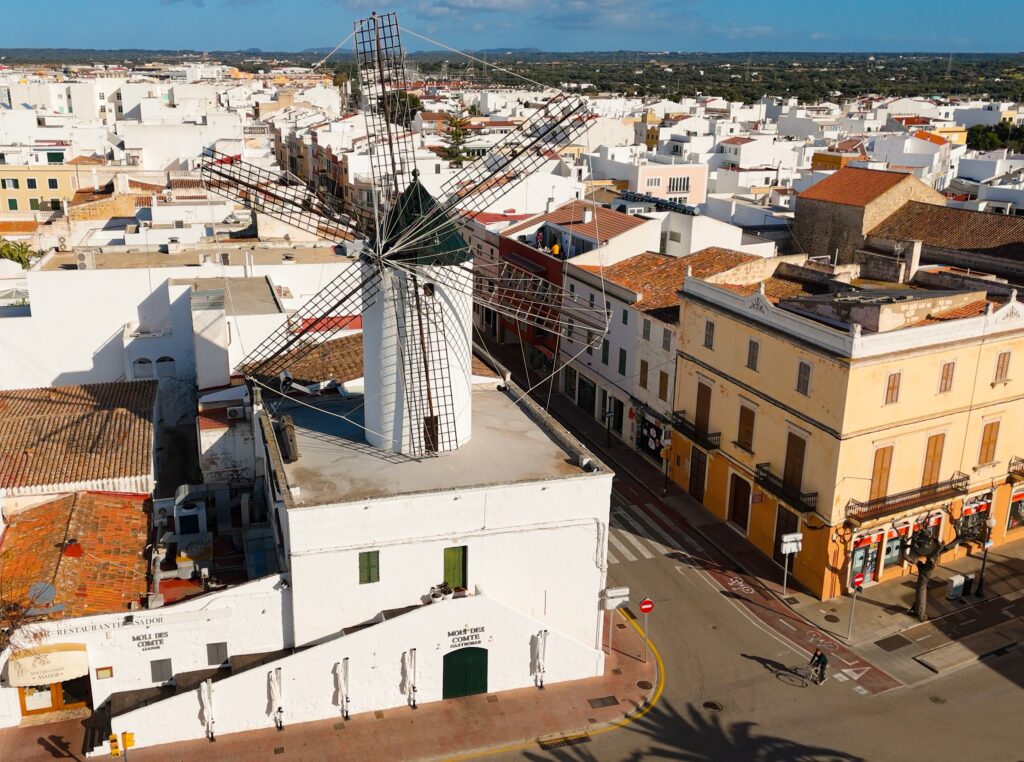
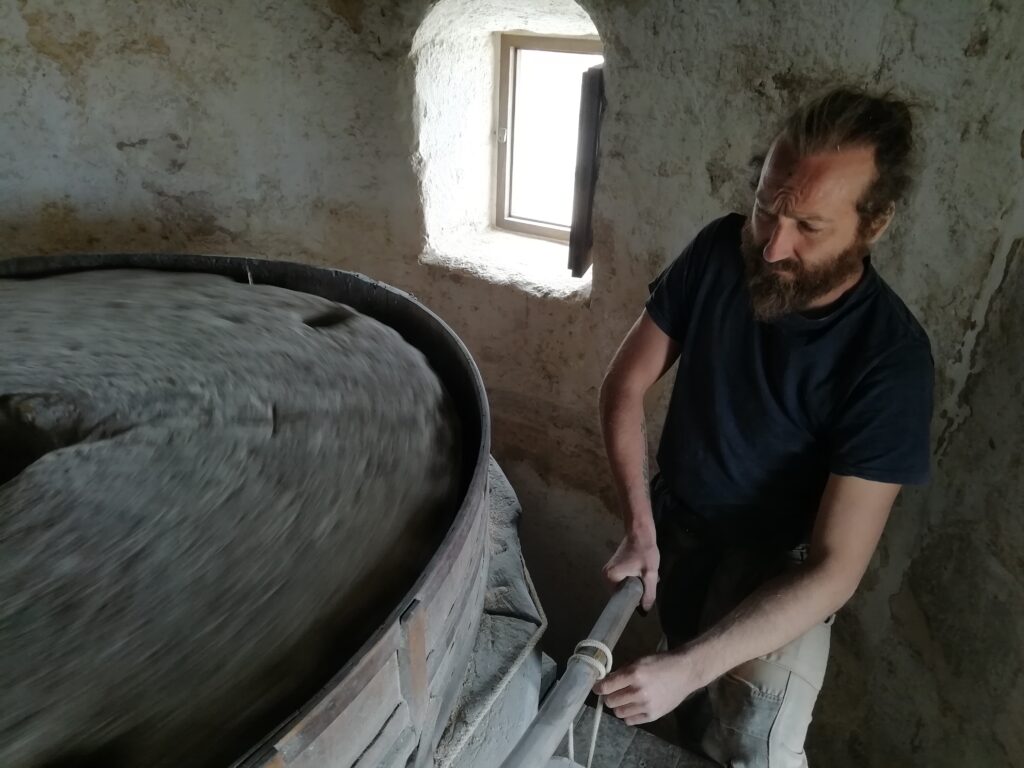
It has happened again. The Fundación José María de Olives y de Ponsich, Conde de Torre-saura has once again brought the Molí des Comte to life. This Friday the mill’s machinery was set in motion again and its wind vanes have started turning once more. It’s an exceptional event that happens once a year when the miller Juan Baptista Sánchez (from Campo de Criptana, Ciudad Real) travels to Menorca to inspect its entire mechanism. It is a maintenance procedure that, for now, has made the Molí des Comte the only one in all of Menorca—along with the Molí de Dalt de Sant Lluís—that is intact and still in operation.
There are no longer any millers in Menorca. That’s why the Foundation entrusted the task of restoring the mill to Juan Baptista, who still takes care of its maintenance and periodically sets it in motion to ensure its preservation, just as it was built.
The Molí des Comte (formerly known as Molí Nou) was built around 1812. It was one of the lasts to be erected, right at the entrance to the old city, which at that time was surrounded by the wall. It is a structure of great heritage value and is very well preserved. It retains the original building and machinery in perfect condition, the miller’s house, and the wheat and flour storage area (which now houses the restaurant of the same name). It was last restored in 2020, when the roof’s and the antennas had to be rebuilt after being severely damaged by a storm a few years in the past. In the 1950s and 1990s, some conservation work had already been carried out.
More history
Its construction was the initiative of Francisca Olives Squella, mother of the first count, Bernat Ignasi Olives, who was named count a few years later, in 1818. It was a time of great splendor for the family: they obtained the count’s title, acquired new estates, and made a major investment to expand, improve, and enrich the family’s estate. The Mill is a reflection of this prosperity and was used to grind the wheat produced by the estates of the county. It ceased operating in 1905.
The Mills
In Menorca, 31 mills are currently preserved. They are only a small part of the large number of mills that were built on the island between the 18th and 19th centuries. Farmers would bring wheat and other grains there to be ground into flour, which was the staple of the diet at that time. They were, therefore, very important structures for the livelihood of the people of Menorca in the past.
They are preserved in Maó (8), Alaior (7), Sant Lluís (3), Es Castell (3), Es Mercadal (3), Fornells (1), Ferreries (1), and Sant Climent (1).
In Ciutadella, four of them have been preserved. Two are on the Torre-saura estate and two in the town. Three of these four were part of the heritage of the former County of Torre-saura. The Molí de ses Roques Llises, better known today as Molí des Cavallitus, belongs to a different property. This one, together with the Molí des Comte, is one of the last to have been built in Ciutadella, of the sixteen that once existed; mills that gradually fell into disrepair as the city expanded beyond the old city walls.