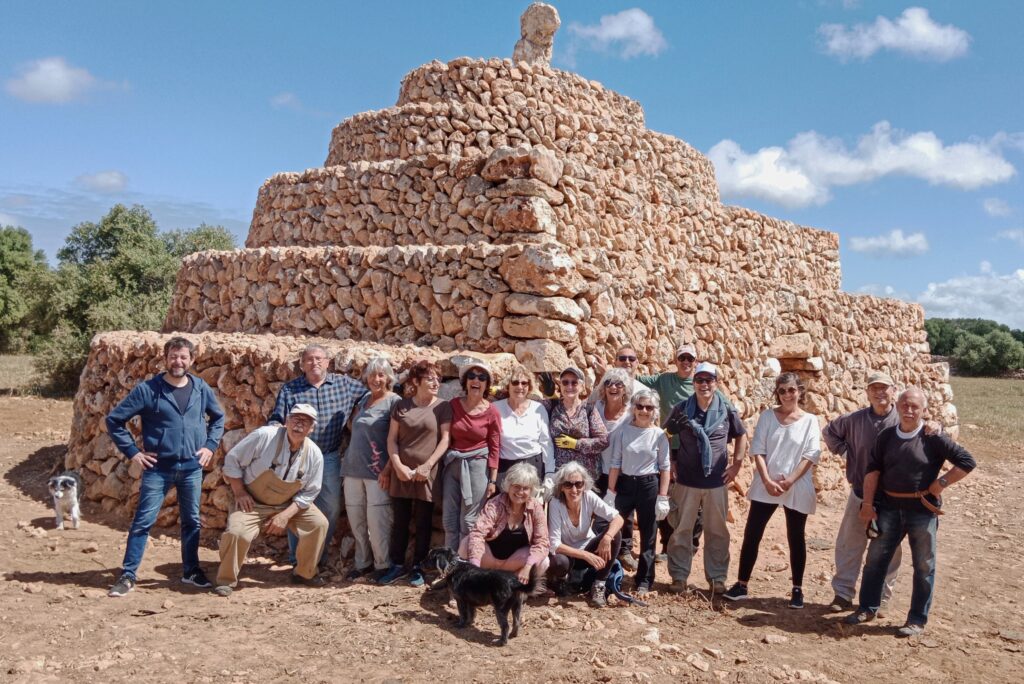
The collaboration between the Fundación José María de Olives y de Ponsich, Conde de Torre-saura and the Societat Històrico-Arqueològica Martí Bella has made it possible to restore the ethnological complex of the Son Saura Vell property, south of Ciutadella de Menorca.
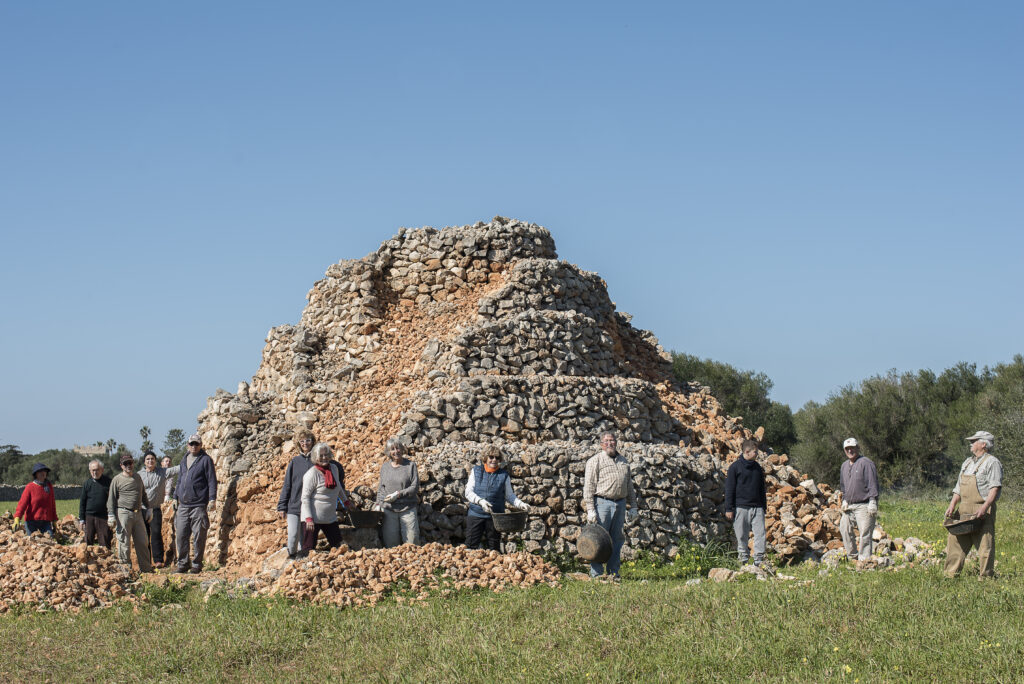
The restoration work has benefited from the selfless participation of volunteers from GIBET (Menorca Ethnological Heritage Intervention Group) of the Societat Històrico-Arqueològica Martí Bella. The work of the team, led by master dry stone wall builder Gabriel Pons Pons, has been supervised by historical heritage technician Antoni Camps Extremera and quantity surveyor Angel Roca Vidal, a member of the Societat Històrico-Arqueològica Martí Bella. The work began in November 2022 and has continued until now.
The seized property
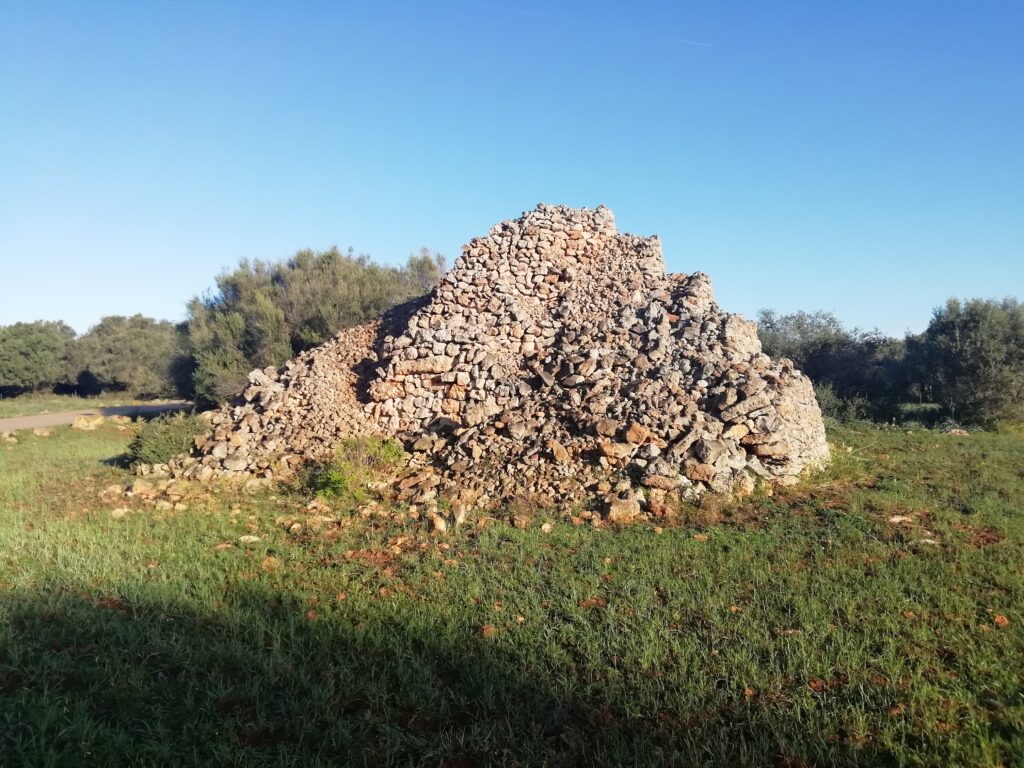
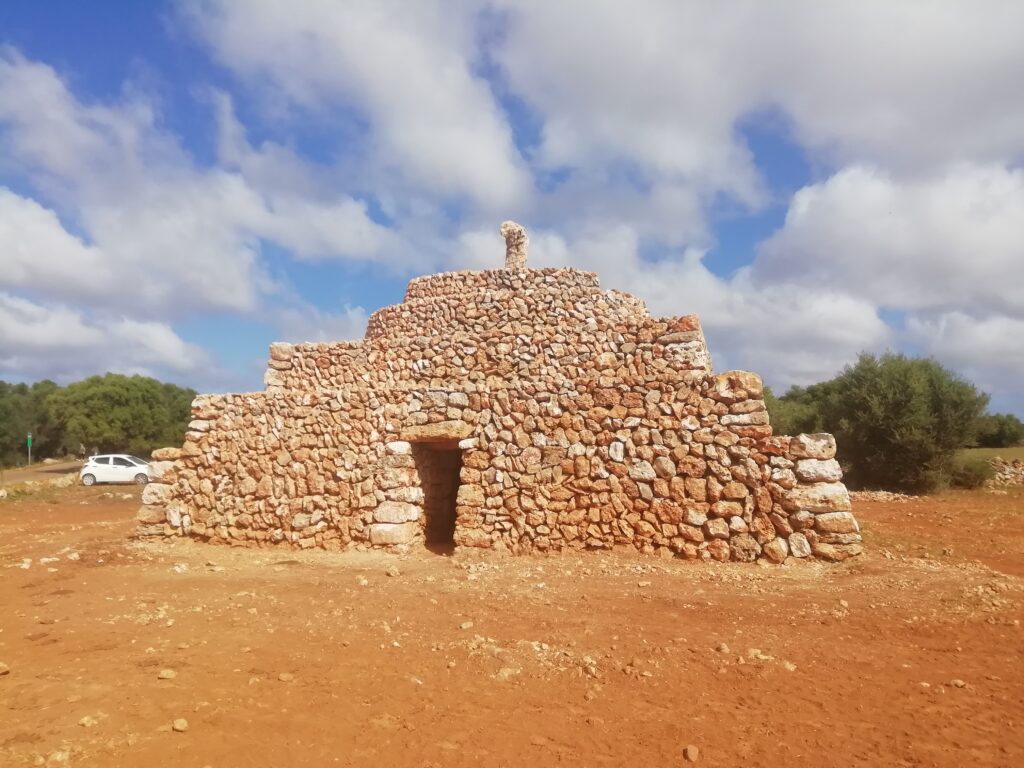
The barraca is a monumental building consisting of five superimposed sections. The first three are semicircular in shape, while the upper two are circular. The straight part of the first two sections forms the façade of the hut, where the interior access door opens, facing south, as it’s common on the island.
The door leads to the interior chamber through a corridor covered with large stone slabs placed horizontally side by side, spanning the width of the first two sections of the hut. The interior chamber has a circular floor plan and is covered with a false vault constructed by approximating dozens of circular rows of stone. The lower rows have been reinforced with traditional mortar.
The intervention consisted of raising the collapsed sections and restoring the hut to its original state. To do this, only the stones that had fallen from the hut over the years were used. In addition, the vegetation that had grown over the hut was removed and the wild olive trees closest to the building were pruned.
Finally, the collapsed parts of a neighbouring barraca were rebuilt and a pont de porquim (a small rectangular building with an arched roof used to shelter pigs) located on the right side of the road leading to Son Saura beach and close to the two barraques that were restored was cleared.
The technical team
The major work was carried out by Gabriel Pons and his team during the second half of April. From November 2022 to May 2023, volunteers from GIBET participated in the project. One of the main objectives of this group is to educate, raise awareness, and promote appreciation among the Menorcan society about the importance of preserving such a vulnerable heritage as ethnological heritage.
It does this mainly by carrying out restoration work on ethnological assets in danger of destruction or deterioration, always on a voluntary basis. GIBET’s most notable actions to date have involved the restoration of dry stone constructions, specifically the barraques and ponts affected by the construction of the southern ring road of Ciutadella (RC-2), a large number of meters of dry stone wall on the public estate of Sa Vinyeta (Ciutadella de Menorca), and the barraques on the municipal estate of Es Pinaret (Ciutadella de Menorca).
A little history
Although archaeological evidence suggests that the technique was already in use in prehistoric times, it is not possible to determine exactly when walls and other dry-stone structures began to be built in Menorca, as the vast majority are anonymous constructions that were never recorded. The first documented references date back to the 14th century, when King Pedro IV of Aragón allowed properties to be enclosed by walls. However, most of the structures that remain on the island today were built in recent centuries, and it was in the 19th century that most of the network of dry-stone walls and other related structures scattered throughout the island was completed, coinciding with the end of the process of enclosing and privatizing communal pastures and dividing up properties.
In addition to serving to delimit the estates, the dry-stone elements arose from the need to remove loose stone from the land to make it cultivable and, in turn, to give it a use, contributing to the need to compartmentalize and organize the different agricultural spaces of the main rural exploitation unit in Menorca. Indeed, the various dry stone elements make it possible to divide the properties into much smaller plots so that their agricultural uses can be rotated and the land is not exhausted, to reduce the effects of wind on crops, to level and make use of sloping land, prevent soil erosion and earth movements caused by rain, channel water to drain flooded land and direct it where desired, protect certain trees from livestock, and provide shelter for livestock anywhere on the farm. These and many other needs are the starting point for the work of a highly specialized professional with close ties to the land: the wall builder, who is primarily responsible for shaping the Menorcan landscape. The presence of dry-stone walls throughout the island makes them one of its most distinctive features. In fact, it has been speculated that there may be between 11.000 and 15.000 linear kilometers of dry-stone walls in Menorca.
The Menorcan countryside is divided into properties that were originally agricultural in nature (the lloc) which, as mentioned above, are enclosed by dry-stone walls. Each property is divided into three fields enclosed by dry-stone walls, which were traditionally left fallow. At the same time, each seedbed is divided into much smaller plots, called tanques, which are also enclosed by the same type of wall. This system has allowed for the development of shepherdless livestock farming based on a simple but effective system of opening and closing the accesses to the tanques for traffic and controlled livestock grazing. This required the construction of additional buildings, using materials obtained from the same site, which served as shelters and met the needs of the herd when required by the annual crop cycle. These buildings are the ponts and barraques found throughout the island.
As mentioned above, it was from the 18th century and throughout the 19th century that the traditional cereal production model was forged, centered on wheat cultivation and complemented by livestock products. This combined model, in a limited territory such as Menorca, required the compartmentalization and organization of agricultural spaces for more sustainable land management. In this way, ponts and barraques were built throughout the territory to shelter livestock.
As with dry-stone walls, barraques and ponts are anonymous constructions of uncertain age. Their characteristics and the degree of mastery and refinement of the technique used in their construction vary from case to case, as does their distribution in space. However, larger barraques, such as the one that has been the subject of this intervention, were built between the 18th and 19th centuries on specific farms, and in addition to their livestock function, they were also a source of enjoyment for the owners of the estates where they were built. Thus, these constructions became a visible symbol of the power and social and economic status of their lineages, as attested by Archduke Ludwig Salvator Habsburg in the volumes dedicated to Menorca in his Die Balearen in Wort und Bild Geschildert (Leipzig, 1869-1891) when he refers to the large barraques on the estates of the Count of Torre-saura and, specifically, to the Barraca des Comte, located on the Ses Truqueries property. It is precisely on certain estates that are or were in the past part of the land holdings of the main landowning families of Menorca that the best examples of this type of construction can be found.
Some dated examples are the Barraca de sa Tanca de sa Bassa (Son Salomó, Ciutadella de Menorca), which has the date 1857 on the lintel of the door; the Barraca de sa Tanca d’Enmig (Ses Truqueries, Ciutadella de Menorca), with the date 1813 in the same place as the previous one; the Pont de s’Aljub (Son Salomó, Ciutadella de Menorca), which has the date 1858 on the lintel of one of its doors, now practically illegible; or the case of the monolith that topped the summit of the Barraca des Comte (Ses Truqueries, Ciutadella de Menorca), which bore the number 94, which has been interpreted as the year 1794.
It is also likely that the construction of the numerous barraques and ponts on certain estates in Ciutadella was a consequence of the surplus labor resulting from the approval in 1820 of a royal decree prohibiting the importation of cereals in order to favor cereal production on the peninsula. This caused the island’s commercial fleet, dedicated to the lucrative business of shipping wheat from the eastern Mediterranean and the Black Sea to Spanish ports, to suffer, forcing many professionals dedicated to or linked to this business to emigrate to North Africa or take refuge in the agricultural sector, a situation that would be skillfully exploited by certain landowners to make significant improvements to their estates and dedicate them to intensive wheat cultivation and livestock breeding for the island and national markets.
Pere Bagur. Photographs by Sonia Rotger – SHA Martí i Bella and Toni Camps