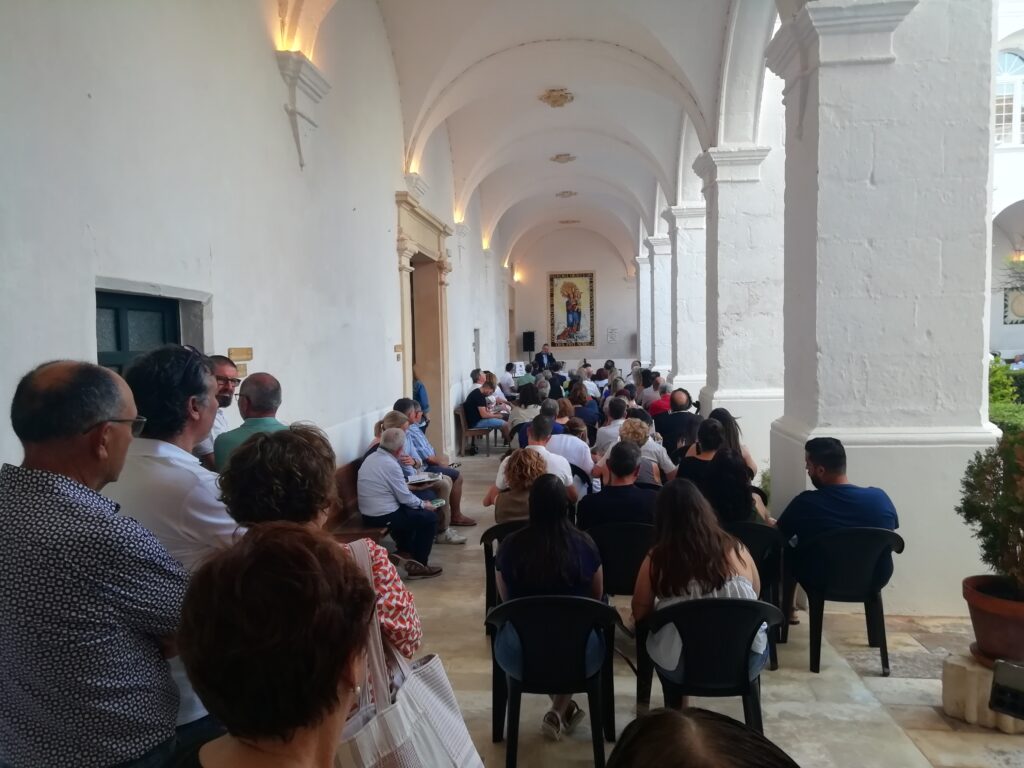
Yesterday, Diari Menorca kicked off the Sant Joan festivities with its now-traditional launch of the Sant Joan 2026 Special, an event held in the cloister of the former Sant Agustí Convent that brought together numerous representatives from public administrations, social and cultural organizations, as well as a large group of attendees.
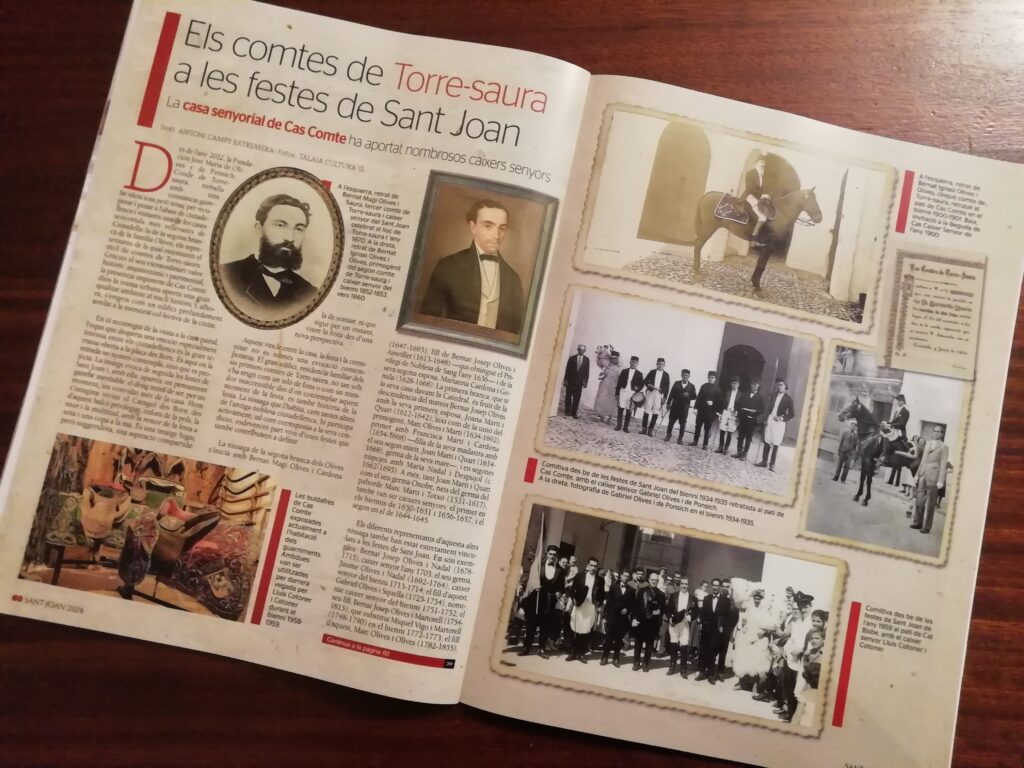
The magazine, which each year symbolically marks the start of the countdown to Ciutadella’s major festivities, once again offers a wide variety of content dedicated to the history, tradition, and current events of Sant Joan. Among the most notable features in this edition is an extensive article dedicated to the Torre-saura Palace because of the close connection this iconic manor House has historically maintained with the festival.
The article, written by historian Toni Camps, analyzes the role played by the second branch of the Olives family, holders of the title of Count of Torre-saura, in the historical development of the celebration, meticulously documenting the participation of numerous members of this lineage in the role of caixer senyor. The report also offers a complete list of those who held this position over the centuries, highlighting the close connection between the Torre-saura Palace, the Olives family, and one of Menorca’s most iconic festive traditions.
Given its undeniable historical and documentary interest, we reproduce below the full text of the article published in the Sant Joan 2026 Special Edition of Diari Menorca.
The Counts of Torre-saura at the Sant Joan Festivities
Since 2022, the Fundación José María de Olives y de Ponsich, Conde de Torre-saura has been working with quiet yet tenacious dedication to restore and make accessible to citizens and visitors one of Ciutadella’s most significant stately homes: that of the second branch of the Olives family, whose representatives held the title of Counts of Torre-saura. Thanks to its extraordinary historical, architectural, and heritage value, the imposing presence of Cas Comte within the urban fabric adds great environmental quality to the historic center and, at the same time, stands as a building deeply rooted in the city’s collective memory
During the tour of the manor house, the space that evokes a particularly intense emotion among the people of Ciutadella is the large terrace opening onto Es Born Square. It is here that the gaze not only contemplates but also projects itself. The image immediately evokes the Sant Joan festivities, and with it comes an almost inevitable thought: the intimate desire to be, for a moment, just another guest of the house. One imagines experiencing the Caragol des Born from this privileged balcony, far from the dust, sweat, and crowds, with the murmur of the festival at one’s feet and a drink in hand. It is a fleeting yet evocative image, a shared aspiration: that of dreaming, even if only for an instant, of experiencing the festival from a new perspective.
This link between the house, the festival, and the community is not merely a contemporary evocation. The grand building, the family residence of the first six Counts of Torre-saura, has not only been erected as a backdrop or an inaccessible vantage point from which to contemplate this moment of the festival; it is also part of the history of the celebration itself. The lineage that inhabited it, like so many others of Ciutadella’s old nobility, actively participated in the festival, as befitted their status, becoming a living part of festivities that they also helped to define.
The lineage of the second branch of the Olives family began with Bernat Magí Olives Cardona (1647-1693), son of Bernat Josep Olives Ametller (1613-1648) —who obtained the Privilege of Nobility by Blood in 1626— and his second wife, Marianna Cardona Gomila (1628-1668). The first branch, whose house is located across from the Cathedral, descends from Bernat Josep Olives himself and his first wife, Joana Martí Quart (1612-1642), as well as from the marriage of his eldest son, Marc Olives Martí (1634-1692), first to Francisca Martí Cardona (1654-1668) —daughter of his stepmother and her second husband, Joan Martí Quart (1614-1668), his mother’s brother— and, in his second marriage, to Maria Nadal Despujol (c. 1662-1695). Furthermore, both Joan Martí Quart and his brother Onofre, grandsons of Marc Martí Totxó’s (1531-1617) brother, were also caixers senyors: the former in the bienniums 1650-1651 and 1656-1657, and the latter in 1644-1645.
The various representatives of this other lineage were also closely linked to the Sant Joan festivities. Examples include: Bernat Josep Olives Nadal (1678-1715), caixer senyor in 1703; his brother Jaume Olives Nadal (1692-1764), caixer senyor for the two-year period 1713-1714; his son, Gabriel Olives Squella (1725-1754), appointed caixer senyor for the two-year term 1751–1752; his son, Bernat Josep Olives Martorell (1754-1815), who replaced Miquel Vigo Martorell (1748-1790) for the two-year term 1772-1773; his son, Marc Olives Olives (1782-1855), caixer senyor for the two-year term 1818-1819; the son of the latter, Bernat Josep Olives Vigo (1820-1895), caixer senyor for the two-year term 1848-1849, replaced by Joan Olivar Martorell (1823-1858); and, finally, the son of the latter, Josep Maria Olives Magarola (1858-1933), mayor for the two-year term of 1880-1881.
Returning to the second branch of the Olives family, Bernat Magí Olives Cardona married Paula Martorell Ametller (1662-1706) and served as caixer senyor during the two-year term of 1674-1675. His eldest son, Bernat Magí Olives Martorell (1678-1728), married to Margarita Quart Squella (1678-1731), continued the lineage and served as caixer senyor during the two-year period 1696-1697, in the year 1700, and during the two-year period 1705-1706. His wife was the last representative of the noble Quart family, which was also deeply rooted in the festivities. His grandfather, Joan Quart Miralles (1620-1672), was caixer senyor of the festivals in 1662 and 1663, and his great-grandfather, Llorenç Quart Gomila (1595-1637), held the position during the two-year period 1624-1625.
The son of Bernat Magí Olives and Margarita Quart, Bernat Ignasi Olives Quart (1709-1764), obtained the Royal Privilege of Nobility by Blood in 1734 and became the principal heir of the Quart family and the second branch of the Olives family. He married Marianna Martorell Squella (1711-1748) and served as caixer senyor from 1743 to 1744. He also replaced Jaume Olives Nadal (1692-1764) during the festivals of 1739 and 1740. His eldest son, Bernat Magí Olives Martorell (1738-1794), presided over the Sant Joan festivities in 1762–1763. He married Francisca Olives Squella (1743–1834), and they had thirteen children.
The eldest, Bernat Ignasi Olives Olives (1767-1833), was granted the title of Count of Torre-saura in 1818. He married Rafaela Squella Olives (1770-1824) in 1795, with whom he had four children. The heir was the eldest son, Bernat Magí Olives Squella (1796-1864), successor to the title and the principal architect of the construction of the grand manor house on Es Born Square, built part on the site of the former Quart family home. The 2nd Count of Torre-saura married Francisca Olives Seguí (1806-1858) in 1818, and twelve children were born of this union. The eldest son, Bernat Ignasi Olives Olives (1824-1859), became the first member of the second branch of the Olives family who, following the conferral of the count’s title, participated in the Sant Joan festivities on behalf of the local nobility, serving as caixer senyor during the 1852-1853 term.
He married Carolina Saura Carreras (1825-1906) in 1850, with whom he had three sons and one daughter. His premature death, which preceded that of his father, meant that the title passed to his eldest son, Bernat Magí Olives Saura (1851-1876). However, he was still a child when his grandfather died and he inherited the title, which is why his mother assumed a preeminent role as protector and administrator of the estate, a function she exercised discreetly alongside her children for nearly half a century, from the death of her father-in-law until her own passing at the age of eighty-one. In the context of the 1868 revolution, the civil authorities’ ban on the nobility presiding over the Sant Joan festivities led to the celebration of traditional festivities in 1870 at the Torre-saura estate, organized by Carolina Saura herself and her brother-in-law Guillem Magí Olives Olives (1839-1878), with her son serving as caixer senyor, who had just turned nineteen. When the Civil Guard stormed the estate to shut down the festivities, it was Carolina Saura herself who confronted the law enforcement officers.
The 3rd Count of Torre-saura died at the age of just twenty-five, causing the title to pass to his brother Gabriel Olives Saura (1854-1902), who married Maria Dolors Olives Magarola (1859-1947) in 1880. The 4th Count served as caixer senyor during the two-year period from 1878 to 1879. His younger brother, Faustí Olives Saura (1856-1935), succeeded Ricard Martorell Fivaller (1854-1907), the 5th Marquis of Albranca, 5th Duke of Almenara Alta, and 8th Marquis of Paredes, in 1896; and the following year, the latter was succeeded by the young Bernat Ignasi Olives Olives (1881-1966) and Gabriel Olivar Olives (1881-1936), who, following the deaths of their respective fathers, inherited the titles of 5th Count of Torre-saura and 9th Baron of Lluriach. In turn, Faustí Olives was appointed caixer senyor for the 1918-1919 term, although he was ultimately replaced by Josep Olivar Olives (1884-1936), brother of the 9th Baron of Lluriach.
The 4th Count had four daughters and a single son, Bernat Ignasi Olives Olives, who, as mentioned, inherited the title and served as caixer senyor during the Sant Joan festivities of 1900 and 1901. He married in 1909 Maria del Pilar de Ponsich de Sarriera (1887-1952), the 7th Marquise of Moyá de la Torre, with whom he had four children. The heir, Gabriel Olives de Ponsich (1911-1953), who received the title of 8th Marquis of Moyá de la Torre upon his mother’s death, served as caixer senyor for the 1934-1935 term.
His sudden death, which preceded that of his father, led to the title of Count passing to his brother Josep Maria Olives de Ponsich (1914-1995), the sixth and last Count of the second branch of the Olives family and the ninth and last Olives to hold the title of Marquis of Moyá de la Torre. He was appointed caixer senyor for the 1958-1959 term, but he was barely able to complete the Dia des Be celebrations in 1958, and it was his brother-in-law Lluís Cotoner Cotoner (1910-1979) who replaced him for both that year’s festivities and the following year’s. Lluís Cotoner, 9th Marquis of Bélgida, was the husband of Maria Dolors Olives de Ponsich (1910-1979), the eldest daughter of the 5th Count of Torre-saura. With him, the participation of direct members of this family in the Sant Joan festivities came to an end.
However, it should be noted that, since then, the Torre-saura Palace has served as a temporary residence for other caixers senyors, such as Dr. Josep Francesc Quadrado Quintana (1939) in 1970, and Guillermo Olives Olivares (1960) during the 2004-2005 biennium, a fact that attests to the symbolic survival of this stately home within the festive ceremony. It should be recalled that the latter is a descendant of the Maó branch of the family, founded by Guillem Olives Olives (1771-1825), brother of the 1st Count of Torre-saura.
Thus, the history of the palace and that of the second branch of the Olives family form an inseparable part of the history of Ciutadella and its festivals. And in that continuous thread between memory and tradition, Sant Joan remains the place where the past does not fade away, but is recognized and projected into the present.